

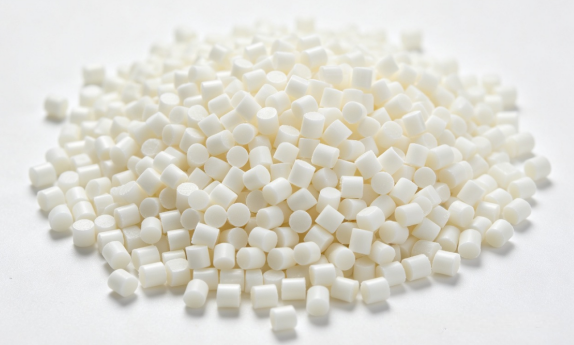
Walk into any office furniture showroom and you will see dozens of chairs that look more or less the same: black frame, mesh back, five-star base, casters. Sit on them for a month and they still feel similar. Come back in two years and the difference is obvious. Some are still tight. Others creak, the back frame has gone chalky, a caster housing has cracked, or the seat pan has started to flex where it never used to.
That gap is rarely about assembly. It is about what the parts are made of.
Plastic is a family, not a material
The word “plastic” gets used as if it describes one thing. It does not. Plastics split into thermoplastics, which soften when heated and can be re-melted, and thermosets, which cure once and cannot be reshaped. Within thermoplastics you then have polypropylene, ABS, polycarbonate, PVC, polystyrene, and a long list of engineering grades. Each one behaves differently under load, heat, sunlight and cleaning chemicals.
Nylon belongs to that same family, which is why saying “nylon versus plastic” is slightly misleading. Nylon is a thermoplastic. What makes it different is its chemistry: the polymer chain carries repeating amide groups (-NH-CO-), and those groups bond to each other. That bonding is the reason a nylon part behaves quite unlike an ABS part of the same shape.
What PA actually is
PA stands for polyamide. The common grades in furniture are PA6 and PA66, with PA12 and PA610 used where dimensional stability matters more than raw strength, and high-temperature grades such as PA46 for difficult applications.
The properties that matter in a chair are fairly specific:
- Toughness. Reinforced PA66 can reach tensile strength above 80 MPa. It is hard and tough at the same time, which is what you want in a back frame that takes repeated lean-back loads.
- Wear resistance and self-lubrication. Low friction makes PA a sensible choice for moving parts: tilt mechanisms, slider blocks, caster components, lumbar adjusters.
- Fatigue resistance. A chair back flexes thousands of times a year. PA holds up under cyclic stress better than most commodity plastics.
- Oil and chemical resistance. Grease, hydraulic oil, and most mild acids and alkalis are not a problem. Strong acids and strong oxidisers are.
- Processing. PA6 melts around 220°C and PA66 around 260°C, and both run well in injection moulding, which is how most chair frames and seat pans are made.
Where nylon is not the answer
A supplier who tells you nylon solves everything is selling, not engineering. The honest list of weaknesses:
- Moisture absorption. Unmodified PA6 and PA66 take on water, expand slightly, and lose a little stiffness in the process. Tight-tolerance parts need conditioning or a low-absorption grade such as PA610 or PA12.
- Cold impact. Standard grades get brittle below zero. Outdoor or unheated-warehouse use needs an impact-modified grade.
- UV. Plain nylon yellows and chalks in sunlight. Outdoor pieces need UV stabilisers or a protective coating.
- Drying before moulding. If the pellets are not dried below roughly 0.2% moisture, you get bubbles, silver streaks and hydrolysis. This is a process discipline issue, not a material one, but it shows up as a material failure.
- Heat ceiling. Standard PA6 and PA66 are comfortable up to about 80–120°C. Beyond that you need a high-heat grade.
- Strong acids and oxidisers. Concentrated sulphuric or nitric acid will attack the part. Normal office cleaning will not.
Why we moved to recycled nylon
The interesting development of the past few years is not a new polymer. It is where the polymer comes from.
Via Furniture chair frames, seat components and structural parts are produced with recycled and recyclable polyamide supplied through a chain certified to the Global Recycled Standard (GRS), version 4.0. The certificate in our file is issued by GCL International Ltd (certificate GCL-304812-GRS-2026, valid to 13 August 2027) and covers the processing stage at our material partner, Zhaoqing Wanxin New Materials Co., Ltd., Textile Exchange ID TE-00348321.
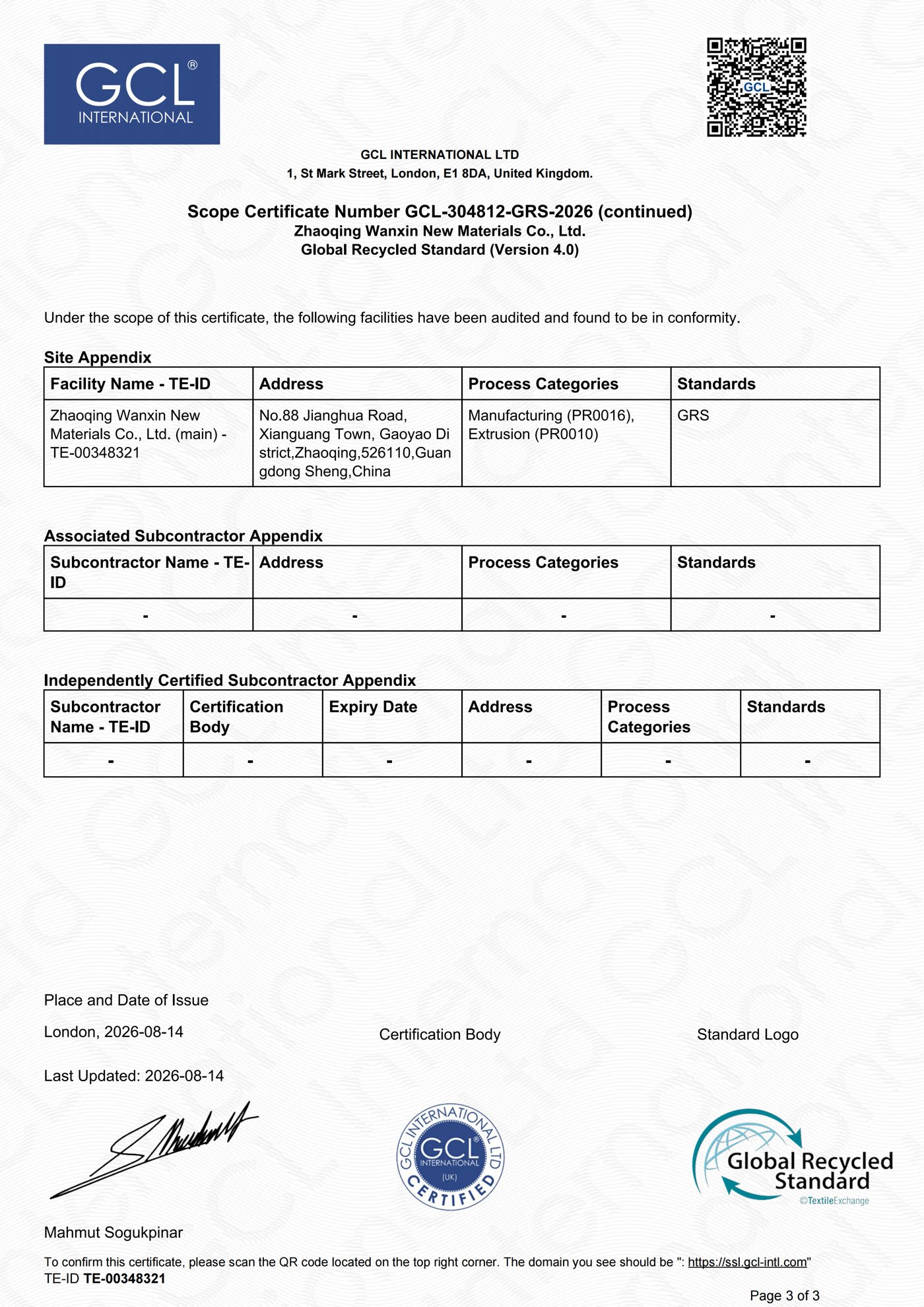
Three points from the certificate are worth spelling out, because buyers tend to skim them:
- The scope is processed post-consumer material, process categories manufacturing and extrusion. In plain terms: the input is recovered nylon, and the output is re-pelletised compound.
- The certified product list covers four grades of processed chips and pellets, including 70% recycled nylon with 30% glass fibre and 82% recycled nylon with 18% TPE. Those are the grades that go into structural chair parts.
- The certificate covers the material, upstream of the finished chair. It does not by itself certify that any particular chair shipped to you is GRS. That requires the transaction certificate chain to follow the order. We are explicit about this because overclaiming is the fastest way to lose a project specifier’s trust.
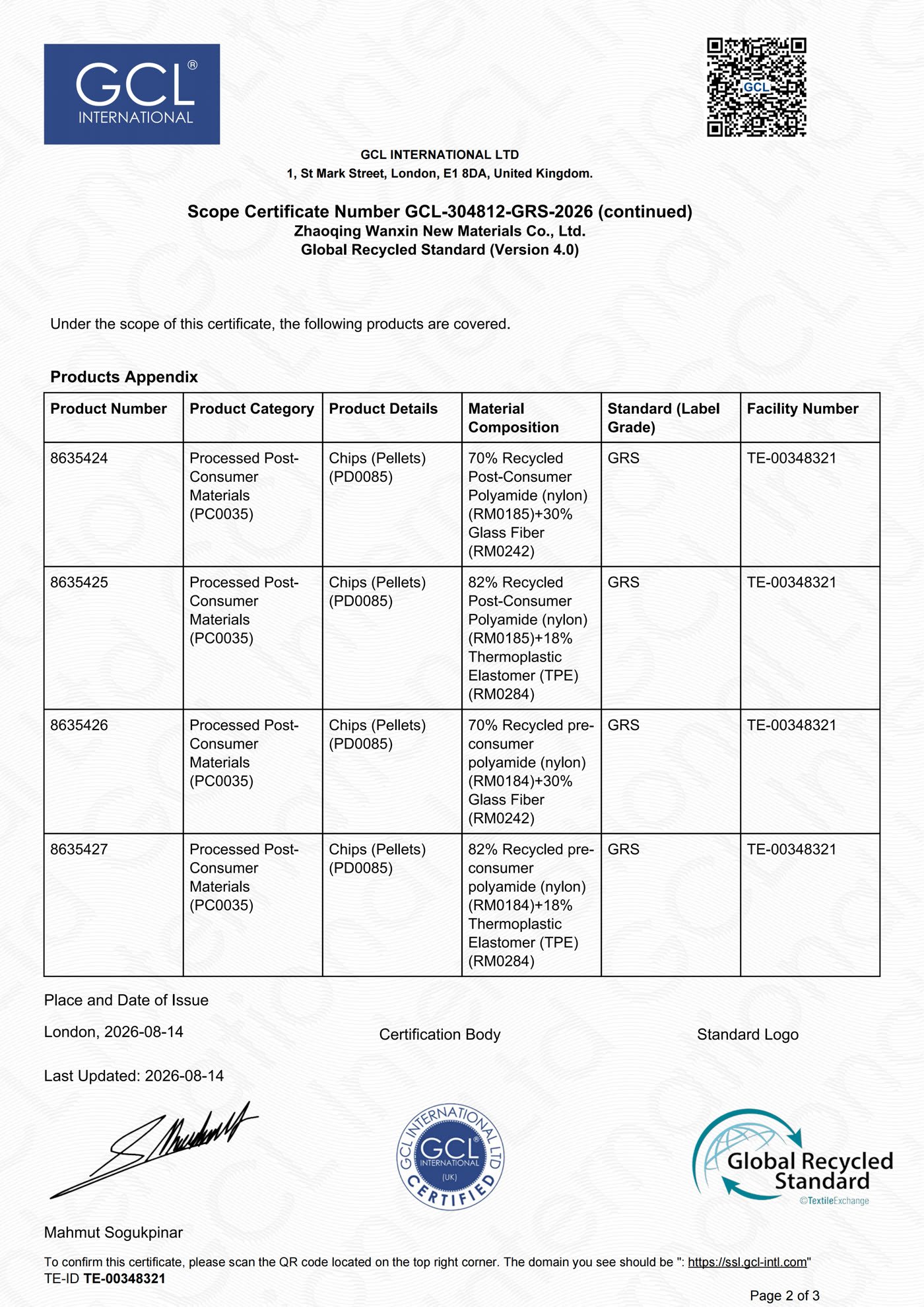
Mechanically, recycled PA is not a downgrade. Glass-fibre reinforced recycled grades hold the stiffness and fatigue behaviour the frame design was calculated around, provided the compounding is controlled and the moulding is dried properly. That is a supplier question, not a marketing question: ask for the grade data sheet and the transaction certificate, not just a logo.

What to ask before you specify
If you are comparing chairs for a project, four questions separate the serious factories from the rest:
- Which polymer, which grade, and is it glass-fibre reinforced? “Nylon” alone tells you nothing.
- Is the recycled content certified, and can you show the transaction certificate for this shipment?
- What happens to the frame at -10°C and after 500 hours of UV exposure? If there is no answer, there is no test data.
- Are the pellets dried before moulding, and what is the recorded moisture level?
None of these are exotic. They are simply the things that decide whether a chair still feels solid in year three.
That is the part of office furniture that photographs badly and matters most.

